
Faiz Ahmed Faiz: Life, Famous Nazms, and Urdu Poetry
Faiz Ahmed Faiz biography, famous nazms like Mujhse Pehli Si Mohabbat, full Urdu text, transliteration, and English meaning. A complete guide to his poetry.
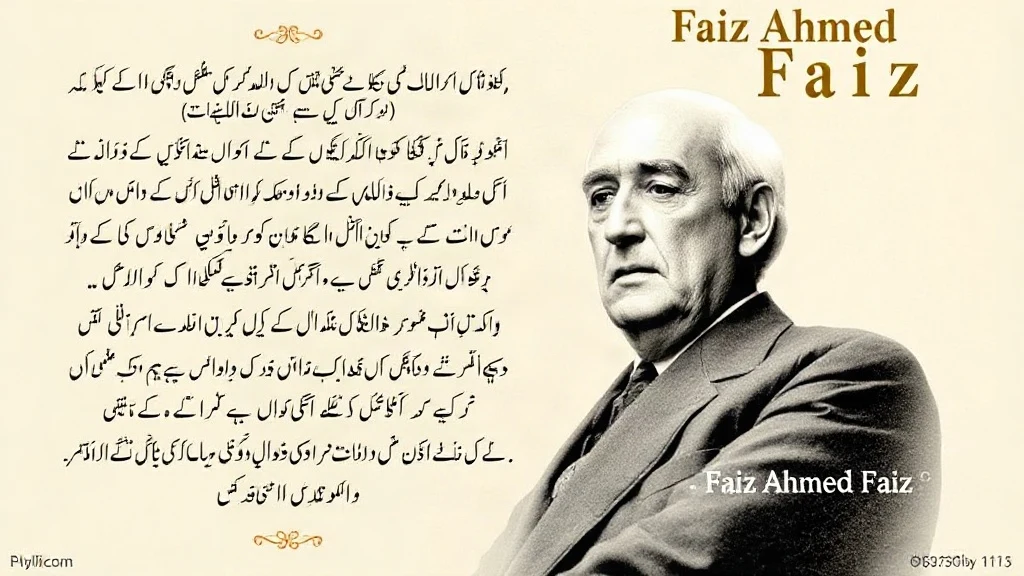
Faiz Ahmed Faiz was one of the most influential Urdu poets of the 20th century. His poetry blends personal love with political resistance, and his nazms like "Mujhse Pehli Si Mohabbat" and "Rang Hai Dil Ka Mere" remain beloved across South Asia. This guide covers his life, his most famous works, and the full Urdu text with transliteration and English meaning for each.
Related reading: Discover our full guide on Best Bewafa Poetry in Urdu: 20 Heartfelt Couplets (2026).
Faiz Ahmed Faiz (1911 to 1984) was a Pakistani poet, journalist, and activist. He won the Lenin Peace Prize in 1962 and was nominated for the Nobel Prize in Literature. His work is known for its revolutionary spirit, its deep romanticism, and its musical quality. He is often called the poet of the people because his verses speak to both lovers and revolutionaries.
Who was Faiz Ahmed Faiz?
Faiz Ahmed Faiz was born on 13 February 1911 in Sialkot, British India, now in Pakistan. He studied Arabic and English literature at Government College Lahore, where he later taught. He served in the British Indian Army during World War II, then worked as a journalist and editor. His political activism led to imprisonment in 1951 in the Rawalpindi Conspiracy Case, and his time in prison shaped some of his most powerful poetry.
Faiz married Alys George, a British-born woman who converted to Islam and took the name Alys Faiz. Their love story appears in many of his poems. He died on 20 November 1984 in Lahore, and his legacy continues through his poetry, his essays, and his influence on Urdu literature.
What are the most famous Faiz Ahmed Faiz poems?
Faiz wrote in many forms, but his nazms, or free-verse poems, are his most celebrated works. His ghazals also remain popular with singers and reciters. Here are the poems most often quoted and performed.
- Mujhse Pehli Si Mohabbat, Mere Mehboob Na Maang
- Rang Hai Dil Ka Mere, Rang Hai Dil Ka Mere
- Subh-e-Azadi, written after the partition of India
- Bol, Ke Lab Azaad Hain
- Dua, a prayer for peace and freedom
- Tanhai, a poem about solitude and longing
Mujhse Pehli Si Mohabbat: full text, transliteration, and meaning
Mujhse Pehli Si Mohabbat, Mere Mehboob Na Maang is perhaps the most famous Faiz Ahmed Faiz poem. It is a nazm in which the speaker tells his beloved not to ask for the same love as before, because the world has changed him. The poem is both romantic and political, as the speaker cannot ignore the suffering around him.
Here is the full Urdu text of the poem.
میرے محبوب نہ مانگ، مجھ سے پہلی سی محبت
میرے محبوب نہ مانگ، مجھ سے پہلی سی محبت
Transliteration: Mere mehboob na maang, mujhse pehli si mohabbat
English meaning: My beloved, do not ask me for the love of before.
The poem continues with lines about the world's sorrows, the cries of the oppressed, and the speaker's changed heart. The repeated refrain, "Mujhse pehli si mohabbat, mere mehboob na maang," is one of the most quoted lines in Urdu poetry.
Rang Hai Dil Ka Mere: full text, transliteration, and meaning
Rang Hai Dil Ka Mere is a ghazal made famous by the Indian singer Asha Bhosle. The song was composed for the film Umrao Jaan, and its lyrics are by Faiz Ahmed Faiz. The ghazal speaks of love, longing, and the color of the heart.
Here is the opening verse in Urdu.
رنگ ہے دل کا میرے، رنگ ہے دل کا میرے
رنگ ہے دل کا میرے، رنگ ہے دل کا میرے
Transliteration: Rang hai dil ka mere, rang hai dil ka mere
English meaning: The color of my heart, the color of my heart.
The ghazal is known for its musicality and its emotional depth. It is often performed at mushairas and concerts, and it remains one of the most popular Faiz Ahmed Faiz ghazals.
What is the theme of Faiz Ahmed Faiz poetry?
The main themes in Faiz Ahmed Faiz poetry are love, revolution, freedom, and human suffering. He wrote about the pain of separation from a beloved, but he also wrote about the pain of an oppressed society. His poetry often connects the personal and the political, showing that love cannot be separated from the world around it.
Faiz also wrote about hope. Even in prison, he wrote verses that looked toward a better future. His poem Dua is a prayer for peace, and his poem Subh-e-Azadi questions the meaning of freedom after the partition of India and Pakistan.
Why is Faiz Ahmed Faiz important in Urdu literature?
Faiz Ahmed Faiz is important because he changed the direction of Urdu poetry. Before him, Urdu poetry was mostly about personal love and mysticism. Faiz added a political voice, using poetry to protest against injustice and to speak for the common people. His work influenced generations of poets, writers, and activists across Pakistan, India, and beyond.
His poetry also crossed borders. It has been translated into many languages, including English, Russian, and French. The Indian poet and politician Agha Shahid Ali translated some of his work, and the American poet Naomi Shihab Nye has also engaged with his verses.
Faiz Ahmed Faiz ghazals and nazms: a comparison
| Form | Example | Main feature |
|---|---|---|
| Nazm | Mujhse Pehli Si Mohabbat | Free verse, longer lines, narrative or reflective |
| Ghazal | Rang Hai Dil Ka Mere | Rhyming couplets, musical, often sung |
| Political nazm | Subh-e-Azadi | Addresses society, freedom, and history |
| Personal nazm | Tanhai | Focuses on solitude, memory, and loss |
Famous quotes by Faiz Ahmed Faiz
Faiz Ahmed Faiz left behind many memorable lines. Here are a few of his most quoted verses with their English meanings.
- Mujhse pehli si mohabbat, mere mehboob na maang. Meaning: Do not ask me for the love of before, my beloved.
- Bol, ke lab azaad hain. Meaning: Speak, for your lips are free.
- Yeh daagh daagh ujala, yeh shab-gazida sahar. Meaning: This stained light, this night-bitten dawn.
- Hum jo tareek raahon mein mare gae. Meaning: We who died on the dark paths.
How to read Faiz Ahmed Faiz in Urdu
To read Faiz Ahmed Faiz in Urdu, start with his collected works, especially the collections Naqsh-e-Faryadi, Dast-e-Saba, and Zindan-Nama. These books contain his most important nazms and ghazals. If you are new to Urdu poetry, read the transliteration alongside the Urdu text, then read the English meaning to understand the context.
Listening to recitations also helps. Many of his poems have been sung by artists like Iqbal Bano, Nayyara Noor, and Asha Bhosle. Hearing the rhythm of the words makes the poetry easier to understand and remember.
Faiz Ahmed Faiz books and collections
Faiz published several poetry collections during his lifetime. Each collection marks a stage in his life and thought.
- Naqsh-e-Faryadi (1941), his first collection, mostly romantic
- Dast-e-Saba (1952), written after his imprisonment
- Zindan-Nama (1956), poems from prison
- Dast-e-Tah-e-Sang (1965), political and revolutionary
- Sar-e-Wadi-e-Sina (1971), later reflections
- Sham-e-Shahr-e-Yaran (1979), poems of friendship and memory
Faiz Ahmed Faiz in popular culture
Faiz Ahmed Faiz poetry appears in films, songs, and political movements. The ghazal Rang Hai Dil Ka Mere was featured in the 1981 film Umrao Jaan. His poem Bol, Ke Lab Azaad Hain became an anthem for free speech movements. In Pakistan, his work is recited at literary festivals, and in India, his verses are taught in schools and universities.
His influence also extends to music. Singers from both India and Pakistan have performed his work, and his poetry continues to inspire new generations of artists.
FAQ about Faiz Ahmed Faiz
When was Faiz Ahmed Faiz born?
Faiz Ahmed Faiz was born on 13 February 1911 in Sialkot, British India, now in Pakistan.
What is the most famous poem of Faiz Ahmed Faiz?
The most famous poem of Faiz Ahmed Faiz is Mujhse Pehli Si Mohabbat, Mere Mehboob Na Maang. It is a nazm about love and the pain of the world.
Did Faiz Ahmed Faiz win the Nobel Prize?
Faiz Ahmed Faiz did not win the Nobel Prize, but he was nominated for it. He won the Lenin Peace Prize in 1962.
What is the meaning of Mujhse Pehli Si Mohabbat?
Mujhse Pehli Si Mohabbat means "Do not ask me for the love of before." It is the opening line of his most famous nazm.
Was Faiz Ahmed Faiz a revolutionary poet?
Yes, Faiz Ahmed Faiz was a revolutionary poet. He used his poetry to protest against injustice, war, and oppression.
Where is Faiz Ahmed Faiz buried?
Faiz Ahmed Faiz is buried in Lahore, Pakistan, at the historic Miani Sahib Graveyard.
Updated 2026
This guide to Faiz Ahmed Faiz was updated in 2026 to include accurate biographical details, full Urdu texts, and English meanings for his most famous poems.
Next story

Best Bewafa Poetry in Urdu: 20 Heartfelt Couplets (2026)
Best bewafa poetry in Urdu with 20 original couplets and longer pieces. Each shayari includes Urdu text and English meaning. Perfect for status and sad moments.